Astro Quality Gates: Why a Passing PR Does Not Deploy
A passing PR build establishes that its configured checks passed. On this site, that result does not publish the candidate: production deployment additionally requires the main ref, an allowed event and a successful build dependency.
The earlier Jekyll setup used proof-html and bundler-audit. The current Astro path uses site-checks.yml for validation and site-quality-gates.yml for Pages deployment. Ruby checks still concern the legacy toolchain; they do not audit the npm dependencies used to build this site.
Separate validation from deployment
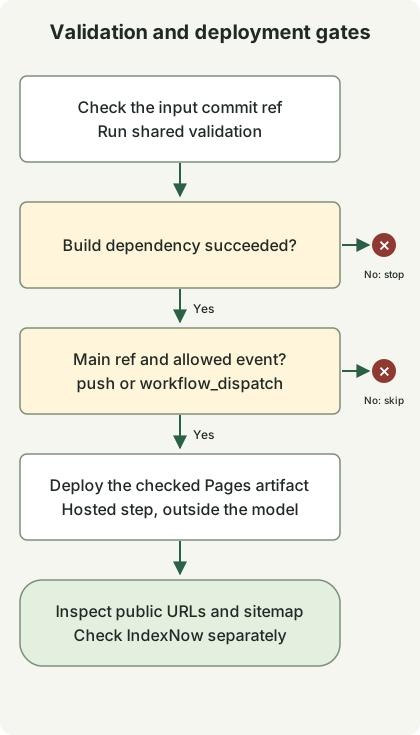
The site workflow passes ${{ github.sha }} to the shared checker. The reusable workflow checks out that input ref, has a build job and read-only contents permissions, and leaves its Pages-artifact option false unless a caller enables it. GitHub’s workflow_call documentation describes that interface.
The configured checks cover different failures:
| Check | What it can establish |
|---|---|
| Python and Node tests | Tested collection, language, publication and rendering contracts |
| Extracted article examples | The examples’ selected execution cases on their recorded toolchains |
npm run check |
Content rules and Astro type/schema checks |
npm run build |
Static output plus internal links, images, anchors and migration coverage |
An internal-link check does not establish external URL availability. A passing example does not establish every production behavior, and a well-formed article can still make an unsupported claim. The active workflow also does not run a general npm vulnerability audit.
Reproduce the selected deployment contracts
With Node 24, run npm ci in a checkout of this repository. Save this complete file as deploy-contract.mjs at the repository root and run:
node deploy-contract.mjsThe script checks the actual YAML values, then models the fixed deployment condition over 24 input combinations. Six deliberately altered workflow objects must fail the contract check. The script has no deploy or network operation.
deploy-contract.mjs
import assert from 'node:assert/strict';
import { readFileSync } from 'node:fs';
import YAML from 'yaml';

const read = file => YAML.parse(readFileSync(`.github/workflows/${file}`, 'utf8'));
const site = read('site-quality-gates.yml');
const checks = read('site-checks.yml');
const condition = "github.ref == 'refs/heads/main' && (github.event_name == 'push' || github.event_name == 'workflow_dispatch')";
function verify(site, checks) {
    assert.equal(site.jobs.deploy.if, condition);
    assert.equal(site.jobs.deploy.needs, 'build');
    assert.equal(site.jobs.build.with.ref, '${{ github.sha }}');
    assert.equal(site.jobs.build.with.pages_artifact, '${{ ' + condition + ' }}');
    assert.deepEqual(Object.keys(checks.jobs), ['build']);
    assert.deepEqual(checks.permissions, { contents: 'read' });
    assert.equal(checks.on.workflow_call.inputs.pages_artifact.default, false);
    assert.equal(checks.jobs.build.steps[0].with.ref, '${{ inputs.ref }}');
    assert.ok(site.jobs.deploy.steps.some(step => step.uses === 'actions/deploy-pages@v4'));
}
verify(site, checks);

// A model of this fixed condition and successful dependency, not the Actions engine.
function allowed(ref, event, build) {
    return build === 'success' && ref === 'refs/heads/main' &&
        (event === 'push' || event === 'workflow_dispatch');
}
const expected = new Set([
    'refs/heads/main|push|success',
    'refs/heads/main|workflow_dispatch|success',
]);
let cases = 0;
for (const ref of ['refs/heads/main', 'refs/heads/develop', 'refs/heads/content/example', 'refs/pull/42/merge']) {
    for (const event of ['push', 'workflow_dispatch', 'pull_request']) {
        for (const build of ['success', 'failure']) {
            assert.equal(allowed(ref, event, build), expected.has(`${ref}|${event}|${build}`));
            cases++;
        }
    }
}

const mutations = [
    (site, checks) => { site.jobs.deploy.if = "github.event_name == 'pull_request'"; },
    (site, checks) => { site.jobs.deploy.needs = []; },
    (site, checks) => { site.jobs.build.with.ref = 'main'; },
    (site, checks) => { checks.permissions.pages = 'write'; },
    (site, checks) => { checks.on.workflow_call.inputs.pages_artifact.default = true; },
    (site, checks) => { checks.jobs.build.steps[0].with.ref = 'main'; },
];
for (const mutate of mutations) {
    const badSite = structuredClone(site), badChecks = structuredClone(checks);
    mutate(badSite, badChecks);
    assert.throws(() => verify(badSite, badChecks), assert.AssertionError);
}
console.log(`${cases} policy-model combinations and ${mutations.length} rejected workflow mutations passed.`);
The checked output is:
24 policy-model combinations and 6 rejected workflow mutations passed.Only successful builds on main with push or workflow_dispatch are allowed in this model. All other combinations are rejected, including a manually dispatched feature branch. A pull_request run normally uses a pull-request merge ref, so its success does not pass this site’s deployment condition. GitHub documents both job conditions and successful dependency requirements.
This is a model of the selected ref/event condition plus a successful build dependency, not an Actions expression interpreter. It tests success and failure states; it does not simulate cancellation, skipped ancestors, runner scheduling, token authorization, artifact provenance or a Pages deployment. The YAML assertions make a changed policy fail for explicit review rather than silently testing the old model against new configuration.
Confirm the published result
After approving and merging a candidate, inspect the main run’s commit, build result and deploy job. A green PR run with deploy: skipped is expected; a successful build alone is not proof of publication. The Pages job uses the checked artifact, following the Astro Pages deployment pattern.
Open the public article and its language links, then check the canonical URL, source dates and sitemap entry. IndexNow runs after deployment with failure-tolerant steps, so it can fail while Pages succeeds. Notification acceptance and sitemap presence also do not prove search-engine indexing or impressions.
The candidate workflow article explains the preceding Draft PR review. Keep technical checks and the decision to publish as separate responsibilities; neither replaces checking the article’s claims.
Discussion