Open-Source Game Engines Compared: Godot, Bevy, Stride and O3DE
On this page
For a small team starting a general 2D or 3D game, Godot is a useful first candidate. Bevy fits a Rust team willing to own more of its tooling; Stride deserves a look for C# workflows; O3DE is worth evaluating when a team can support a larger 3D content and build pipeline. These are starting points for validation, not a performance ranking.
This is a document-based comparison for developers choosing a game engine. The release references checked on November 2, 2026 are Godot 4.7.2, Bevy 0.20, Stride 4.4 and O3DE 26.05. The runnable example below tests only a small Godot movement function; it does not establish the other engines’ editor experience, rendering speed or export reliability.
What are we comparing?
All four projects call themselves game engines. Their workflows differ: an integrated visual editor and a code-driven ECS workflow leave different amounts of tooling for the team to assemble. A framework or rendering library can also be appropriate, but compare the missing scene, asset and editing tools as work the team must supply.
| Engine and release reference | Development workflow | First question before committing |
|---|---|---|
| Godot 4.7.2 | Scene/node editor with scripting | Does the chosen language export to the actual target? |
| Bevy 0.20 | Rust systems and components, built around ECS | Can the team maintain tooling and API migrations? |
| Stride 4.4 | C# and Game Studio | Is the editor available on the development machines? |
| O3DE 26.05 | Extensible 3D editor and component pipeline | Can the team build, import assets and package a small scene? |
The scenarios below are recommendations derived from these workflows. They are not accounts of a team shipping a game with each engine.
Which engine fits the team’s workflow?
Godot: start with the complete authoring loop
Godot is a reasonable baseline when the team wants to edit scenes, attach behavior and iterate in one environment. Its MIT license permits proprietary games; distributing the engine still requires the relevant copyright and license notices. Plugins, fonts, music and models have their own terms.
Check the language/platform combination early. The Godot web export documentation currently says Godot 4 C# projects cannot export to the web. A desktop C# prototype is therefore not evidence of browser delivery. For consoles, Godot’s porting guidance describes platform approval, official SDKs and private export templates or third-party providers. An open-source engine does not remove that process.
Bevy: choose Rust and tooling ownership together
Bevy is an engine, not just a renderer. Its introduction describes Rust, ECS and a choice of MIT or Apache 2.0 licensing. It also warns about breaking API releases and potentially difficult migrations.
This makes Bevy interesting for a team that wants systems and components to be central to its development model. Treat editor integration, asset iteration and version migration as items to demonstrate with the team’s project. Familiarity with Rust alone does not establish a faster authoring loop, and a parallel ECS does not prove better frame times for a particular game.
Stride: separate C# support from editor availability
Stride’s FAQ describes MIT licensing and no engine royalties. Its C# workflow can make it a useful candidate for an existing .NET team.
The platform matrix distinguishes development hosts from game targets: Windows has full editor support; Linux and macOS support building/code-only workflows with qualifications, and the editor is not natively available outside Windows. The 4.4 announcement reports improvements to non-Windows builds. Do not turn those improvements into a claim that the same editor workflow is available everywhere.
O3DE: evaluate the pipeline before the showcase
O3DE is worth shortlisting for a team prepared to own an extensible 3D pipeline. Its license file specifies Apache 2.0 by default with an MIT option and identifies separate third-party components. The download page lists Windows/Linux packages and substantial development-machine requirements. Those are host requirements, not a blanket list of game export targets.
Start with a representative asset import, project build and packaged scene. The 26.05 release notes mark the new particle system experimental and discourage production use. A feature appearing in release notes does not automatically make it a production-ready dependency.
Does “free” mean open source or cost-free production?
No. Source access and zero purchase price do not establish an open-source license. For example, Defold currently describes itself as source available; evaluate its specific license rather than automatically grouping it with the four engines above.
Engine licensing also does not pay for console porting, asset licenses, hosting, plugins or maintenance. Before deciding, identify which parts the engine supplies, which parts require another license, and which parts the team will build. Avoid estimating a total cost without that scope.
What should a small prototype verify?
Give shortlisted engines the same acceptance task: load one representative asset, implement one interaction and create a build for the intended target. Record setup, repeat-edit-run friction and any unsupported requirement. This is a proposed evaluation, not a benchmark performed for this article.
Here is one reproducible part: a headless Godot movement check. It accepts a position, synthetic direction and elapsed seconds, caps direction magnitude at 1, applies speed and clamps the resulting point to a rectangle. Inputs are assumed finite and elapsed time nonnegative. The clamp is not obstacle collision, sprite-size handling or a physics simulation.
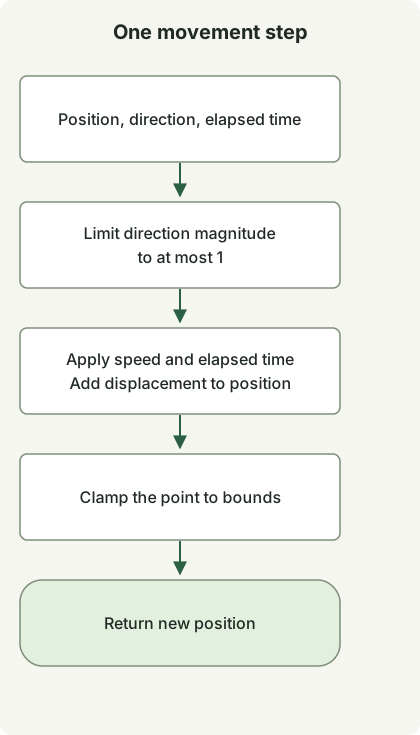
The diagram shows one call to advance. The test harness below repeats calls and checks results; it does not read a keyboard or render a character. Vector2’s reference documents the vector operations. This keeps the tested behavior separate from claims about editor productivity or game performance.
With the standard Godot 4.7.2 editor binary available as godot, save project.godot and movement.gd in the same directory. No scene, external asset, package or network access is required to run the script after installing the engine.
project.godot:
config_version=5movement.gd:
extends SceneTree

const SPEED := 120.0
const LIMIT := Vector2(640.0, 360.0)

func advance(pos: Vector2, direction: Vector2, delta: float) -> Vector2:
    var bounded := direction.limit_length(1.0)
    var next := pos + bounded * SPEED * delta
    return next.clamp(Vector2.ZERO, LIMIT)

func _initialize() -> void:
    var cases := [
        [Vector2(100, 100), Vector2.ZERO, 0.5, Vector2(100, 100)],
        [Vector2(100, 100), Vector2.RIGHT, 0.5, Vector2(160, 100)],
        [Vector2.ZERO, Vector2(1, 1), 1.0, Vector2(84.852814, 84.852814)],
        [Vector2.ZERO, Vector2(0.5, 0), 1.0, Vector2(60, 0)],
        [Vector2(639, 100), Vector2.RIGHT, 1.0, Vector2(640, 100)],
        [Vector2(5, 100), Vector2.LEFT, 1.0, Vector2(0, 100)],
        [Vector2(100, 359), Vector2.DOWN, 1.0, Vector2(100, 360)],
        [Vector2(100, 100), Vector2.RIGHT, 0.0, Vector2(100, 100)],
    ]
    for sample in cases:
        var actual := advance(sample[0], sample[1], sample[2])
        if not actual.is_equal_approx(sample[3]):
            push_error("movement mismatch")
            quit(1)
            return
    var split := advance(advance(Vector2(100, 100), Vector2.RIGHT, 0.25), Vector2.RIGHT, 0.25)
    if not split.is_equal_approx(advance(Vector2(100, 100), Vector2.RIGHT, 0.5)):
        push_error("time-step mismatch")
        quit(1)
        return
    print("movement cases=9")
    quit(0)
Run it from that directory using Godot’s command-line interface. On macOS, replace godot with the installed bundle’s Godot.app/Contents/MacOS/Godot path if it is not on PATH.
godot --headless --no-header --path . --script movement.gd --quit-after 1The example was executed locally on macOS with Godot 4.7.2. Its output was:
movement cases=9The checks cover idle input, horizontal and diagonal movement, partial input magnitude, upper/lower bounds, zero elapsed time and a split-time step away from the bounds. They do not verify rendering, target-device export, obstacles, networking or comparative performance.
How should the final choice be made?
Choose the candidate that satisfies the game’s required workflow and target build with a maintenance burden the team can accept. If a visual editing loop is the priority, begin the prototype with Godot. If the team explicitly wants Rust/ECS ownership, test Bevy’s tooling and migration costs. For a C# team, test Stride on the actual editor hosts. For a larger 3D pipeline, validate O3DE’s asset/build loop before relying on a showcase feature.
The next useful artifact is a small target-device build and a list of unmet requirements, not a universal engine ranking. Keep that decision evidence alongside the project so an engine upgrade can be evaluated against the same behavior.
Discussion