Remove Adjacent Duplicate Pairs in Java with an ArrayDeque Stack
A stack solves adjacent equal-character pair removal in one traversal by retaining the reduced result of the prefix already read. If the next character matches the top, remove the pair; otherwise push it.
The exercise accepts 1–1,000,000 lowercase English letters and returns 1 if everything can be removed, or 0 otherwise. Even total counts for each character are insufficient because removal depends on adjacency.
Processing flow
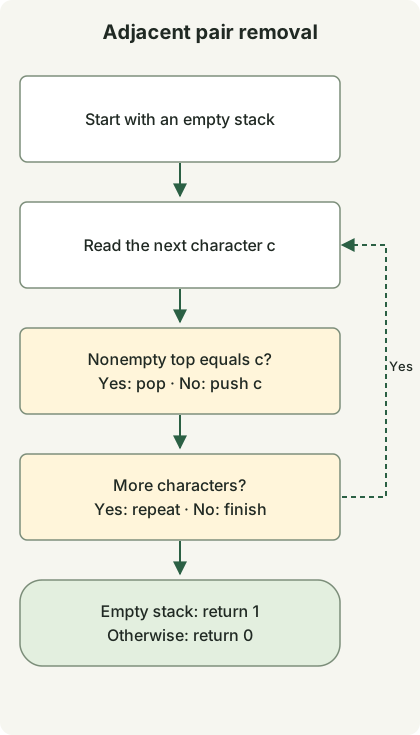
The stack stores the reduced prefix. Each new character removes the equal top or becomes the new top.
Retain the reduced prefix
Save the full class as Solution.java. It was compiled for Java 11 and executed on JDK 17.
import java.util.ArrayDeque;
import java.util.Deque;

public class Solution {
    public int solution(String s) {
        Deque<Character> stack = new ArrayDeque<>();
        for (int i = 0; i < s.length(); i++) {
            char c = s.charAt(i);
            if (!stack.isEmpty() && stack.peek() == c) stack.pop();
            else stack.push(c);
        }
        return stack.isEmpty() ? 1 : 0;
    }
}
The stack contains the processed prefix with no remaining equal adjacent pair. A matching next character creates a removable pair at the boundary, so pop. A different character creates no such pair, so push. The same invariant then holds for the next step.
| Character read | Stack: bottom → top |
|---|---|
| b | b |
| a | ba |
| a | b |
| b | empty |
| a | a |
| a | empty |
Thus baabaa returns 1. In contrast, abab returns 0 despite both characters having even counts: no equal characters are adjacent. The stack handles boundaries exposed by removal without repeatedly replacing text across the whole string.
ArrayDeque and complexity
Use ArrayDeque through Deque’s push, peek, and pop operations. Because c is a primitive char, stack.peek() == c unboxes Character for comparison; it does not compare object identity.
Each character is pushed at most once and popped at most once. With amortized deque operations, time is O(n), and worst-case additional space is O(n) when characters remain. Execution checks include a million repeated characters and a million alternating characters with no removable pairs. These are boundary checks, not a speed benchmark or a memory guarantee for every environment.
What you retain depends on the problem: the missing runner exercise needs name frequencies rather than adjacent order.
Discussion