Generate an x-Spaced Sequence in Java: Promote Before Multiplication
The n values starting at x are x × 1 through x × n. Because results can exceed int range, both the result array and the multiplication itself must use long.
The exercise bounds x from -10,000,000 to 10,000,000 and n from 1 to 1,000. The final value can therefore have magnitude 10,000,000,000, requiring a long array.
Processing flow
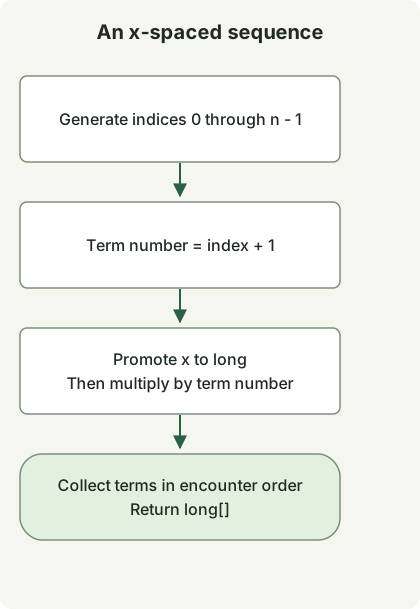
Turn zero-based indices into term numbers, promote x to long before multiplication, and collect in order.
Convert an index to a term number
Save this complete class as Solution.java. It was compiled for Java 11 and executed on JDK 17.
import java.util.stream.IntStream;

public class Solution {
    public long[] solution(int x, int n) {
        return IntStream.range(0, n)
                .mapToLong(i -> (long) x * (i + 1))
                .toArray();
    }
}
IntStream.range(0, n) generates indices from 0 through n-1. Multiplying by i + 1 makes the first value x and the last x×n. Starting at x×0 would change the required sequence.
| x | n | Result |
|---|---|---|
| 2 | 5 | [2,4,6,8,10] |
| -4 | 2 | [-4,-8] |
| 0 | 3 | [0,0,0] |
A negative x produces decreasing values, while x=0 produces only zeros. Preserve term order; this is not a sorting problem.
mapToLong alone does not protect the product
Even inside mapToLong, evaluating x * (i + 1) first uses int multiplication because both operands are ints. (long) (x * (i + 1)) also converts after overflow has occurred.
The example promotes an operand first with (long) x * (i + 1). Checks cover the full reference arrays ending at 10,000,000,000 and -10,000,000,000 for the positive and negative bounds. Smaller positive, negative, and zero inputs are also compared against arrays constructed by repeated addition.
Time is O(n), and space including the returned array is O(n). This follows the exercise contract rather than implementing general validation of sequence size or arbitrary API input.
Compare signed sums and array dot products for calculations that fit int under their bounds. The Java coding exercise guide connects array calculations with strings and collections.
Discussion