Find the Missing Runner in Java with Name Frequencies
To find the missing runner, count people per name rather than checking only whether a name exists. Subtract completion frequencies from participant frequencies; the exercise guarantees that exactly one name remains with count 1.
The input contract allows up to 100,000 participants, one fewer finisher, and duplicate names. Names contain 1–20 lowercase English letters. The completion list is assumed to be a valid participant list with one person removed.
Processing flow
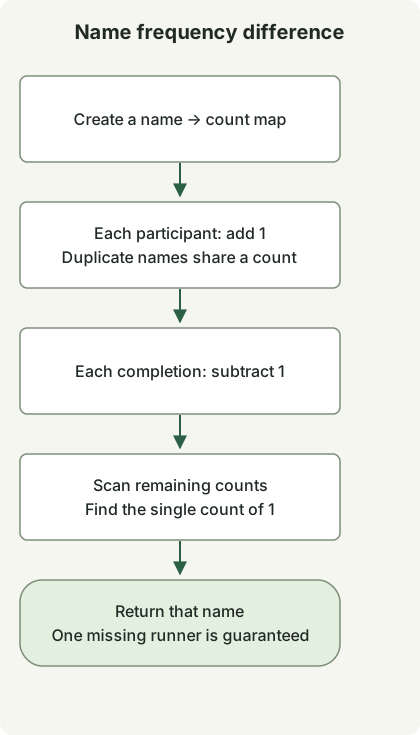
Count every participant, subtract every completion, then return the name whose remaining count is one.
Store the count difference
Save this full class as Solution.java. It was compiled for Java 11 and executed on JDK 17.
import java.util.HashMap;
import java.util.Map;

public class Solution {
    public String solution(String[] participant, String[] completion) {
        Map<String, Integer> counts = new HashMap<>();
        for (String name : participant) counts.merge(name, 1, Integer::sum);
        for (String name : completion) counts.put(name, counts.get(name) - 1);
        for (Map.Entry<String, Integer> entry : counts.entrySet()) {
            if (entry.getValue() == 1) return entry.getKey();
        }
        throw new IllegalArgumentException("Expected exactly one missing runner");
    }
}
merge(name, 1, Integer::sum) starts a new name at 1 and increments existing names. Each finisher reduces that name’s count by one. For participants [ana, bob, ana] and finishers [bob, ana], ana remains at 2 - 1 = 1.
Set subtraction would lose the fact that two people were named ana. Counts retain multiplicity while representing one missing person. Reordering the completion array does not change the result.
Do not rely on HashMap order
HashMap does not guarantee iteration order. Returning the first positive entry works because valid input leaves exactly one such entry, not because iteration has a particular order. The code returns the name with remaining count 1.
The final exception is not complete input validation. A general reconciliation API would need additional policies and checks for unknown finishers or multiple missing people.
With name length bounded by 20 and average constant-time hash operations, time is O(n), with O(u) additional space for u distinct names. No benchmark establishes streams or loops as universally faster.
When only distinct kinds matter, a Set is sufficient; compare the selection bound in the Ponketmon exercise.
Discussion