JDK 25 ScopedValue: Request Context Beyond ThreadLocal
On this page
In JDK 25, ScopedValue is a finalized API for binding data such as request context to a bounded execution scope and passing it from callers to callees. It was finalized by JEP 506, so no preview flags are needed. A binding applies while the operation supplied to run() or call() executes; normal completion or an exception restores the previous state.
How does it differ from ThreadLocal?
Consider it when passing a tenant or trace ID deep into service code would otherwise require adding a parameter to every intermediate method. Ordinary parameters can remain clearer when the value is an explicit input to business logic.
ThreadLocal changes the current thread’s value through set() and removes it through remove(). Request-scoped use requires careful cleanup, typically in finally. Instead of leaving a value set, ScopedValue runs the operation that needs it inside a binding.
| Comparison | ThreadLocal | ScopedValue |
|---|---|---|
| Data access | Read and change a value stored for the current thread | Read the binding in the current dynamic execution scope |
| End of scope | Manage request-scoped cleanup explicitly | Restore the previous binding when run() or call() ends |
| Different value in a callee | set() can change the existing stored value |
Rebind in a nested scope, then restore the outer value |
| Suitable uses | Mutable per-thread state, among others | Request context passed from callers to callees, among others |
ScopedValue neither replaces every use of ThreadLocal nor deprecates it. A private static final field stores an access key, not the context value itself. The same key can resolve to different values depending on the executing thread and scope.
Observe scope and restoration in a virtual thread
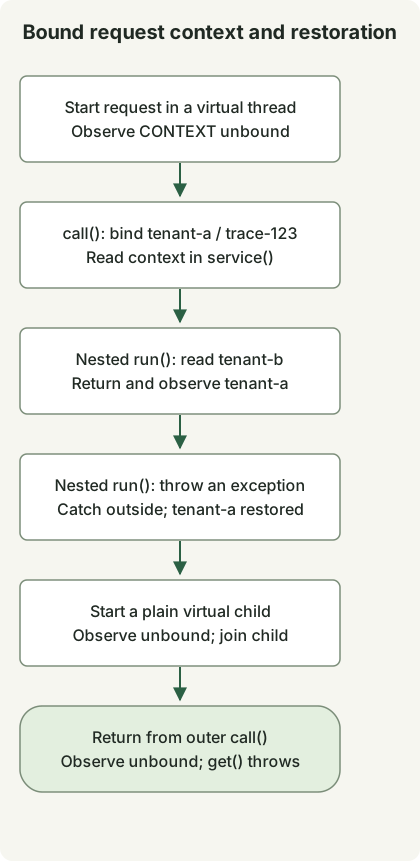
The diagram follows the example below. The outer tenant is tenant-a; the nested scope reads tenant-b. A failing nested scope is caught outside that scope before restoration is checked. This example demonstrates request-context semantics without an HTTP server or framework integration.
Run it in a directory where javac and java point to the same JDK 25 installation. The local verification environment was Eclipse Temurin 25.0.5+8 on macOS AArch64. ScopedValue belongs to java.lang and needs no explicit import.
ScopedContextExample.java
import java.util.NoSuchElementException;
import java.util.concurrent.Executors;

public class ScopedContextExample {
    private static final ScopedValue<RequestContext> CONTEXT = ScopedValue.newInstance();
    record RequestContext(String tenant, String traceId) {}

    public static void main(String[] args) throws Exception {
        try (var tasks = Executors.newVirtualThreadPerTaskExecutor()) {
            tasks.submit(ScopedContextExample::handleRequest).get();
        }
    }

    private static String handleRequest() throws InterruptedException {
        System.out.println("virtual=" + Thread.currentThread().isVirtual());
        System.out.println("before=" + CONTEXT.isBound());
        String result = ScopedValue.where(CONTEXT,
                new RequestContext("tenant-a", "trace-123")).call(() -> {
            System.out.println("outer=" + service());
            ScopedValue.where(CONTEXT,
                    new RequestContext("tenant-b", "trace-123")).run(() ->
                System.out.println("nested=" + service()));
            System.out.println("restored=" + service());

            try {
                ScopedValue.where(CONTEXT,
                        new RequestContext("tenant-fail", "trace-123")).run(() -> {
                    throw new IllegalStateException("demonstration");
                });
            } catch (IllegalStateException expected) {
                System.out.println("after-failure=" + service());
            }

            Thread child = Thread.ofVirtual().start(() ->
                System.out.println("plain-child-bound=" + CONTEXT.isBound()));
            child.join();
            return service();
        });
        System.out.println("result=" + result);
        System.out.println("after=" + CONTEXT.isBound());
        try {
            CONTEXT.get();
        } catch (NoSuchElementException expected) {
            System.out.println("outside=" + expected.getClass().getSimpleName());
        }
        return result;
    }

    private static String service() {
        RequestContext context = CONTEXT.get();
        return context.tenant() + "/" + context.traceId();
    }
}
javac --release 25 ScopedContextExample.java
java ScopedContextExampleThis standard output was observed without preview options. Calling get() on the Future propagates task failures to the caller; join() waits for the child thread’s output.
virtual=true
before=false
outer=tenant-a/trace-123
nested=tenant-b/trace-123
restored=tenant-a/trace-123
after-failure=tenant-a/trace-123
plain-child-bound=false
result=tenant-a/trace-123
after=false
outside=NoSuchElementException
service() reads the current binding without a context parameter. Use run() for an operation without a result and Carrier.call() for an operation that returns a result or propagates an exception. Merely creating a Carrier with where() does not activate a binding.
Both restored and after-failure show the outer value. After the outer call() finishes, isBound() is false, and an unbound get() throws NoSuchElementException. Leaving a binding neither guarantees immediate garbage collection of the referent nor automatically closes an AutoCloseable resource.
Does creating a virtual thread inherit the value?
An ordinary Thread.ofVirtual().start() does not automatically inherit its parent’s binding. The example demonstrates this with plain-child-bound=false. Do not assume that handing work to an ExecutorService or CompletableFuture automatically propagates context either. The first virtual thread in the example establishes its binding inside the task rather than inheriting one.
The official inheritance rules describe capturing bindings when a StructuredTaskScope is created and inheriting them in children started through that scope’s fork(). Structured concurrency is a separate preview API in JDK 25, covered by JEP 505, and is not used by this article’s code. Do not interpret the example as verifying that inheritance mechanism.
Boundaries when adopting request context
An unchangeable binding does not make its referent deeply immutable. The example uses a record containing two strings; a mutable collection would require a separate concurrency design. Keep access to the key narrow too.
Check the JDK 25 API instead of copying older preview examples from JDK 21 and similar releases unchanged. In particular, JDK 25 does not permit orElse(null). A binding to null is also distinct from having no binding.
First distinguish a ThreadLocal that passes request data down the call chain from one that maintains mutable state during execution. For the former, design both the entry-point binding and asynchronous boundaries. Framework transactions, MDC and security context are not connected automatically; this example does not verify those integrations or performance. Continue with the JDK 21 feature article for virtual-thread behavior itself.
Discussion