Java Project Valhalla: Value Objects, Records and the JDK 28 Preview
On this page
Project Valhalla is an OpenJDK project that lets data without a need for object identity use value objects, giving the JVM more freedom to store and pass it efficiently. Checked on October 31, 2026, the project page and JEP 401 show the first value-object preview integrated into JDK 28. This is not a finalized feature. The example below ran on JDK 28 EA Build 21.
Why value classes when Java already has records?
Ordinary objects have identity even when their fields match. Mutable accounts and lock objects need that distinction, but data such as a coordinate (3, 4) may only need its value.
A record declares data components and provides accessors, constructors and methods such as equals(). Existing ordinary records still let == distinguish two separately constructed objects with matching components. The value modifier makes a separate choice: removing object identity. It can be combined with records as value record.
| Declaration | Meaning in this example |
|---|---|
record IdentityPoint(int x, int y) |
Retains distinct object identities even with matching components |
value record ValuePoint(int x, int y) |
Instances of the same class with the same field state are not distinguished by identity |
value record Label(String text) |
Lacks identity, but == and equals() still need not agree |
A value class’s instance fields are final. This does not automatically make referenced objects deeply immutable: a mutable collection stored in a field can still change its contents. Value objects are still handled through object references; they do not become primitive types.
Try the JDK 28 preview
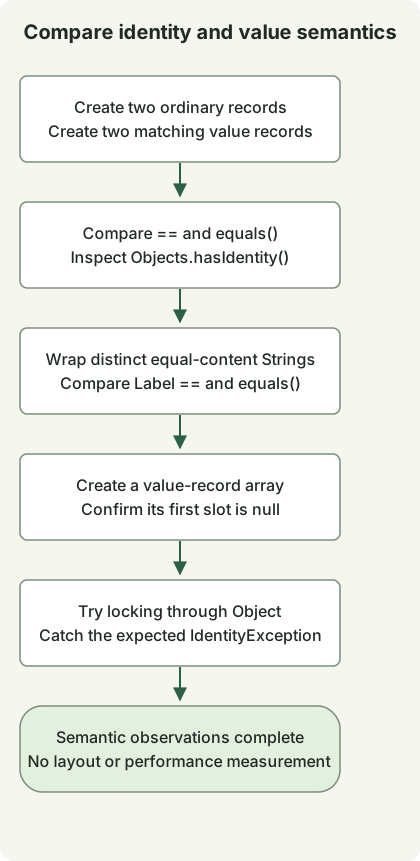
The diagram follows the code below. Label contains distinct String objects with matching contents to expose reference-field comparison. Finally, the program checks that moving a value object into an Object variable does not make it a valid monitor, and handles the expected exception.
Use a separate experiment directory where javac and java point to the same JDK 28 EA build. Compare the download against its official SHA-256 and confirm the build with java --version. JDK 17 and 21 cannot compile this syntax. Preview flags are required at both compilation and execution.
ValhallaExample.java
import java.util.Objects;

public class ValhallaExample {
    record IdentityPoint(int x, int y) {}
    value record ValuePoint(int x, int y) {}
    value record Label(String text) {}

    public static void main(String[] args) {
        IdentityPoint a = new IdentityPoint(3, 4);
        IdentityPoint b = new IdentityPoint(3, 4);
        ValuePoint p = new ValuePoint(3, 4);
        ValuePoint q = new ValuePoint(3, 4);
        System.out.println("record == " + (a == b));
        System.out.println("record equals " + a.equals(b));
        System.out.println("value == " + (p == q));
        System.out.println("value equals " + p.equals(q));
        System.out.println("record identity " + Objects.hasIdentity(a));
        System.out.println("value identity " + Objects.hasIdentity(p));

        Label first = new Label(new String(new char[] {'x'}));
        Label second = new Label(new String(new char[] {'x'}));
        System.out.println("label == " + (first == second));
        System.out.println("label equals " + first.equals(second));

        ValuePoint[] points = new ValuePoint[1];
        System.out.println("array slot null " + (points[0] == null));
        Object monitor = p;
        try {
            synchronized (monitor) {
                throw new AssertionError("A value object must not be a monitor");
            }
        } catch (IdentityException expected) {
            System.out.println("monitor " + expected.getClass().getSimpleName());
        }
    }
}
javac --enable-preview --release 28 ValhallaExample.java
java --enable-preview ValhallaExampleThis output was observed on OpenJDK 28-ea+21-1707 for macOS AArch64. The compiler’s preview notice is separate from this standard output.
record == false
record equals true
value == true
value equals true
record identity true
value identity false
label == false
label equals true
array slot null true
monitor IdentityException
The ordinary records return true from equals() but false from ==. The value records have only integer fields, so their matching field state makes both comparisons true. Objects.hasIdentity() exposes the distinction too.
Should value objects be compared with ==?
Continue using equals() for domain equality. For value objects, == compares field state within the same value class and recursively applies == to reference fields. Referents with identity remain distinguishable when they are separate objects, even if their contents match. Primitive fields are compared by bit pattern, which can also differ from semantic floating-point equality. See value-object comparison rules in JEP 401 for the precise rules.
The two Label objects have strings with matching contents, so their generated record equals() returns true. Their strings are distinct identity objects, so == returns false. Do not interpret value as making every reference field use content-based comparison.
The new value-array slot is null, and dynamically using a value object as a monitor throws IdentityException. Directly locking an expression whose type is clearly a value class may instead be rejected at compilation. Check identity-sensitive uses such as locking and identity-based caches before migration.
Does this immediately save memory or enable List?
Removing identity gives the JVM room for flattening, representing a reference through field state rather than a pointer, and scalarization, passing values as separate components in registers and similar locations. The language does not guarantee a particular layout, eliminated allocations or speedup. The output above checks semantics; it does not measure heap usage or throughput.
Valhalla spans multiple JDK releases. The official roadmap separates value objects from null-restricted storage, array enhancements, unifying primitives and classes, and the Parametric JVM for generic specialization. JEP 401 alone does not complete List<int> or guarantee contiguous storage for every array. The accompanying JEP 539 supplies JVM support for strict field initialization; it does not add an arbitrary strict field modifier to Java source.
Start experiments with small data types such as coordinates or monetary amounts that do not need identity, comparing behavior on the same build. Check framework, serialization and locking dependencies, then measure allocation, GC and throughput on representative workloads before judging the benefit. Do not treat this preview as a finalized, supported feature when choosing a production JDK. Continue with the JDK feature guide for the distinction between final and preview features.
Discussion