Nginx4Shell response guide — NGINX HTTP/2 affected versions and patches
Start by checking which NGINX listeners accept HTTP/2. Disclosed on November 18, 2026, CVE-2026-123007 and CVE-2026-123633 can corrupt memory during HTTP/2 processing. Depending on the conditions, a worker may crash or remote code may execute with worker privileges. The fixed NGINX Open Source releases are stable 1.30.7 and mainline 1.31.9. Check the vendor’s fixed releases for distribution packages, NGINX Plus, and Ingress products. NGINX security advisories · F5 November 18 security update
Which deployments are affected?
Nginx4Shell is a search alias used in this guide. Record both CVE IDs separately in change tickets and asset inventories so you can match each product to its advisory and patch status.
| CVE | Conditions and impact | Affected NGINX Open Source versions |
|---|---|---|
| CVE-2026-123007 | Memory corruption can occur when NGINX processes client HTTP/2 traffic. Check servers that only serve static content if they also have HTTP/2 enabled. | 1.9.5–1.30.6 and 1.31.0–1.31.8 |
| CVE-2026-123633 | NGINX can access freed memory under certain conditions when forwarding client HTTP/2 requests to an upstream. Check HTTP/2 reverse proxies first. | 1.19.7–1.30.6 and 1.31.0–1.31.8 |
For both vulnerabilities, 1.30.7 is the fixed stable release. Although its number is higher than 1.30.7, 1.31.8 is still affected. This update also includes fixes for HTTP/3, the DNS resolver, and the mail proxy. Keep preparing the product patch while using HTTP/2 configuration changes as a temporary mitigation. NGINX release announcements · F5 CVE-2026-123007 · F5 CVE-2026-123633 · CERT-EU advisory
Identify the running product and HTTP/2 path
- Identify the source of the running binary. On a VM, check the executable and package used by the service. In a container, check the running image and its digest. Run
nginx -Vin that environment to see the version and build options. Some distributions, including Ubuntu 24.04 LTS, backport fixes to an existing version. The Ubuntu advisory lists1.24.0-2ubuntu7.20as the fixed package for this release. NGINX command-line options · Ubuntu USN-9159-1 - Check the inbound hop from the client or front proxy to NGINX. A browser can use HTTP/2 to reach a CDN while the CDN uses a different protocol to reach the NGINX origin. Inspect the running service’s configuration with
nginx -T, checking thehttpandserverblocks, included files, and syntax in use. The full output can contain internal addresses and secrets, so inspect it in an authorized environment. NGINX HTTP/2 module documentation - Patch affected instances that accept external requests first. After deployment, confirm that the running processes use the new binary or image. Run the configuration check
nginx -tand verify normal HTTP requests, upstream health, error rates, and worker restarts. In a cluster, check for replicas still running the old image. CERT-EU advisory
If you cannot update immediately, disabling HTTP/2 on affected listeners can reduce exposure to both CVEs. Use http2 off; with the current syntax. For older syntax, remove the http2 option from listen. Check paths that depend on HTTP/2, such as gRPC, before the change. Afterward, verify real connections to those listeners and normal service requests. NGINX HTTP/2 configuration documentation · Red Hat mitigation guide
Exercise — turn your findings into patch priorities
The example takes the product source, version, and HTTP/2 status that you verified. It runs on Python 3.10 or later using only the standard library. Use the results of the preceding checks to prioritize patches.
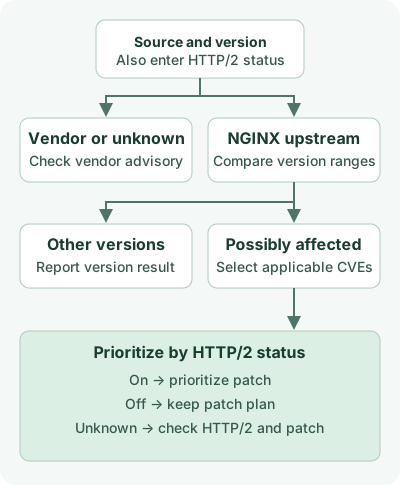
Save the script as nginx_http2_triage.py. Use upstream only for Open Source builds distributed by the NGINX project. Use vendor for packages with backported fixes or vendor images. Set the relevant input to unknown if you have yet to verify the product source or listener configuration.
import argparse
import re


def upstream_version(value: str) -> tuple[int, int, int]:
    if not re.fullmatch(r"[0-9]{1,4}\.[0-9]{1,4}\.[0-9]{1,4}", value):
        raise argparse.ArgumentTypeError("use an upstream version such as 1.30.7")
    major, minor, patch = map(int, value.split("."))
    return major, minor, patch


def triage(origin: str, value: str, http2: str) -> str:
    if origin != "upstream":
        return "CHECK_VENDOR_ADVISORY"

    version = upstream_version(value)
    if version[0] != 1 or version > (1, 31, 9):
        return "CHECK_CURRENT_ADVISORY"
    if (1, 30, 7) <= version < (1, 31, 0) or version == (1, 31, 9):
        return "UPSTREAM_FIX_VERSION"

    affected = [
        cve
        for cve, first_version in (
            ("CVE-2026-123007", (1, 9, 5)),
            ("CVE-2026-123633", (1, 19, 7)),
        )
        if version >= first_version
    ]
    if not affected:
        return "OUTSIDE_LISTED_RANGES"

    action = {
        "on": "PRIORITIZE_PATCH",
        "off": "PATCH_STILL_REQUIRED",
        "unknown": "VERIFY_HTTP2_AND_PATCH",
    }[http2]
    return f"{action} {' '.join(affected)}"


def main() -> None:
    parser = argparse.ArgumentParser()
    parser.add_argument("origin", choices=("upstream", "vendor", "unknown"))
    parser.add_argument("version")
    parser.add_argument("http2", choices=("on", "off", "unknown"))
    args = parser.parse_args()
    try:
        print(triage(args.origin, args.version, args.http2))
    except argparse.ArgumentTypeError as error:
        parser.error(str(error))


if __name__ == "__main__":
    main()
python3 nginx_http2_triage.py upstream 1.31.8 on
python3 nginx_http2_triage.py upstream 1.30.7 on
python3 nginx_http2_triage.py upstream 1.19.6 unknown
python3 nginx_http2_triage.py vendor 1.24.0-2ubuntu7.20 onThe commands above produced the following output on Python 3.13.0.
PRIORITIZE_PATCH CVE-2026-123007 CVE-2026-123633
UPSTREAM_FIX_VERSION
VERIFY_HTTP2_AND_PATCH CVE-2026-123007
CHECK_VENDOR_ADVISORY
The CVE list shows potential exposure based on the version. Check the actual listener configuration to determine whether the upstream condition for CVE-2026-123633 applies. The example classifies operator inputs using published version ranges. Checking the production configuration and patch status remains an operator task.
Discussion